Welcome to CCLP’s 2026 legislative priorities page! Learn more about our priorities on this page and see our bill positions in our 2026 bill tracker.
CCLP’s priority platform for 2026
Our 2026 legislative platform identifies three policy areas where we can make real change with other advocacy groups, community members, legislators, and state leaders.

Advancing economic justice
Advocating for tax and wage reforms that ensure corporations and the wealthy pay their fair share and reduce burdens on working Coloradans.

Defending public programs
Supporting functional, person-centered public programs that improve health, meet changing needs, support the workforce, and lift Colorado’s economy.

Strengthening consumer rights
Protecting community members from exploitative business practices and working to break cycles of debt and poverty.
CCLP’s bills for 2026
Stay tuned as our priority bills are introduced in the Colorado legislature! Updated 5/27/2026
Colorado Fiscal Institute's 2026 Fiscal Policy Package
This agenda seeks to mitigate harm caused by the federal changes to tax laws under H.R. 1, close inequitable and ineffective tax loopholes, and ensure that Colorado families benefit from Colorado’s tax code by restoring a version of the Family Affordability Tax Credit. Learn more with the fact sheet.
HB26-1221: Tax Expenditure Adjustments
This bill creates a new, refundable tax credit to help families with kids, based on their income and the ages of their children. It also starts charging sales tax on most downloaded software in 2027 and uses that money to help pay for the new family tax credit. Learn more with the fact sheet.
HB26-1289: Modification of Certain Tax Expenditures
This bill creates a new refundable tax credit for families with children, funded by applying sales tax to most downloaded software starting in 2027.
CCLP proudly SUPPORTS the Colorado Fiscal Institute’s 2026 Fiscal Policy Package!
Status: HB26-1221 and HB26-1222 were postponed indefinitely on 5/11/2026. HB26-1223 was signed into law on 6/4/2026 and HB26-1289 was signed into law on 6/3/2026.
Protect Colorado Farmworkers / Protege a los Trabajadores Agrícolas
The Colorado Senate is planning to roll back overtime for agricultural workers in Colorado! Senate Bill 26-121, Overtime Threshold for Agricultural Employees, would raise the overtime threshold to 56 hours a week, which would damage worker health and increase economic inequality.
Agricultural workers labor in dangerous conditions and they deserve protections to reduce workplace injuries and support their well-being.
CCLP OPPOSES SB26-121 because we advocate to protect Colorado farmworkers! Learn more with the fact sheet. And tell lawmakers to protect the rights of Colorado’s agricultural workers!
Status: Signed into law on 5/4/2026
**********
El Senado de Colorado tiene planes de reducir las horas extras para los trabajadores agrícolas del estado! El proyecto de ley 26-121 elevaría el umbral de horas extras a 56 horas semanales, lo que dañaría la salud de los trabajadores y agravaría la desigualdad económica.
Los trabajadores agrícolas trabajan en condiciones peligrosas y merecen medidas de protección para reducir los accidentes laborales y velar por su bienestar.
¡CCLP SE OPONE al proyecto de ley SB26-121 porque defendemos la protección de los trabajadores agrícolas de Colorado! Obtén más información en la ficha informativa.
Estado: Promulgada el 4 de mayo de 2026
Protect Coloradans from high drug prices
Colorado’s Prescription Drug Affordability Board (PDAB) is leading the nation in addressing skyrocketing prescription drug costs.
Senate Bill 26-140, would prevent Colorado’s Prescription Drug Affordability Board (PDAB) from reviewing the cost of hundreds of commonly-prescribed medications that Coloradans struggle to afford every day.
As health care costs rise for Coloradans and more people are pushed off of health coverage, our state should be using every tool it can to reduce costs for consumers. Prescription drugs don’t work if people can’t afford them.
CCLP OPPOSES SB26-140 because we advocate to protect Coloradans from high drug prices! Learn more with the fact sheet.
Status: Postponed Indefinitely on 4/22/2026
Medical Debt Protection Act
House Bill 26-1267, Limitations on Collection Actions for Medical Debt, also known as the Medical Debt Protection Act would prohibit medical creditors from collecting unpaid medical debts by:
- Pursuing non-patients
- Garnishing wages
- Placing a lien or foreclosing on a patient’s primary residence
- Attaching or foreclosing on a patient’s car or other personal property
- Threatening immigration consequences
- Seeking arrest or detainment
- Attaching or seizing a patient’s bank account if the patient has less than $15k
- Attaching or seizing retirement accounts or accounts designed for individuals with disabilities
The bill also ensures all creditors are listed as plaintiffs in a collections action and requires permissible actions for collection of medical debt to be initiated within three years after the debt was incurred.
CCLP proudly SUPPORTS the Medical Debt Protection Act! Learn more at Center for Health Progress.
Status: Postponed Indefinitely on 3/31/2026
Legislative wrap-up
Read our 2026 legislative wrap-ups!
2026 Bill tracker
Stay up to date on CCLP’s bill positions!
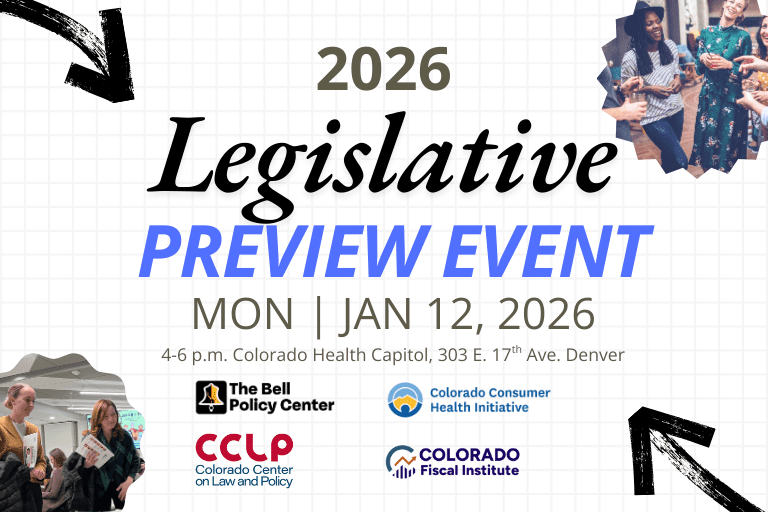
2026 Legislative Preview
Watch our 2026 Legislative Preview with Colorado Consumer Health Initiative, Colorado Fiscal Institute, and The Bell Policy Center!
2026 Skills2Compete Workforce and Skills Legislation at the Capitol
S2C bill positions regarding skills training for adult workers.
Final update: 6/10/2026