Jun 30, 2025

Karly Kaufman serves as Communications Manager for CCLP. Staff page ›

Recent articles

CCLP’s 2025 legislative wrap-up, part 1

by | Jun 30, 2025

Introduction

Colorado’s 2025 regular legislative session came to an end on Wednesday, May 7, 2025. A total of 657 bills were introduced, with over 300 bills coming from each chamber. At the start of the session, the one thing on everyone’s minds was our state’s budget, or lack thereof. As the session continued in the midst of disastrous and sudden changes from the federal government, however, priorities shifted, and strategies evolved.
Click on the image to expand.

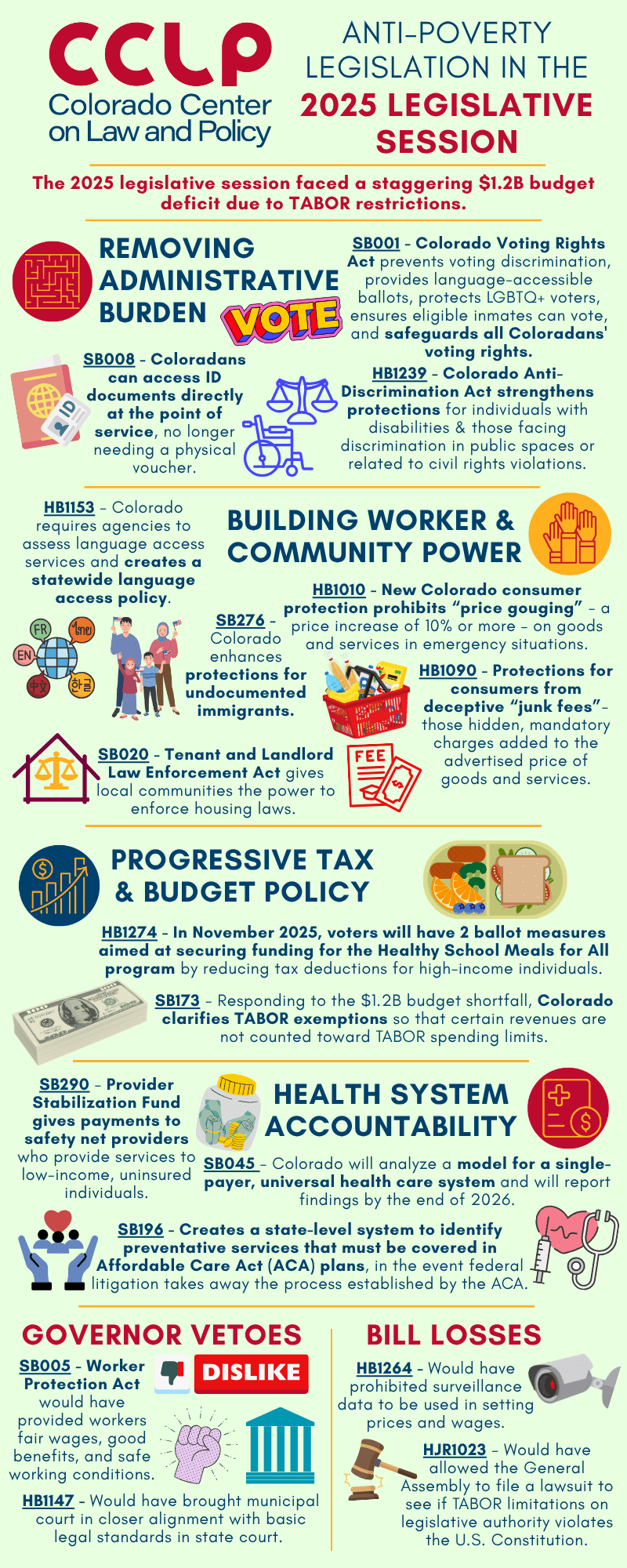
This year’s session faced a staggering $1.2 billion budget deficit, largely due to Taxpayer’s Bill of Rights (TABOR) restrictions that continue to strangle our state’s ability to retain funding for necessary programs, resources, and services. TABOR is the most restrictive tax and revenue limitation in the country, interfering with our state’s ability to invest in our schools, parks, and provide health care to Coloradans. Colorado is unable to backfill state funding because of TABOR, leaving our state vulnerable to the looming federal cuts.[1]

Because of the budget shortfall, bills with fiscal notes faced uncertain fate, as these costs could be the downfall of effective and progressive policies. Bills without fiscal notes were able to move along in the legislative process much quicker because of this. Several bills were even introduced to maneuver funding around to balance the budget.

This year was nothing shy of chaos, but we maintained strong alliances and powered through to pass critical and transformative legislation to build a more equitable state for all Coloradans.

CCLP

CCLP focused on four priority areas this session where the opportunity existed to make real change in Colorado: removing administrative burden, building worker and community power, advocating for progressive tax and budget policies, and improving health system accountability. We took a position on 58 bills this year — 46 support, six oppose, and six monitor. Of these 58 bills, 36 became law, 18 lost or were postponed indefinitely, and four were vetoed by Colorado Governor Jared Polis.

Among these positions, we identified seven priority bills, including Senate Bills 005, Worker Protection Collective Bargaining; 008, Adjust Necessary Document Program; 276, Protect Civil Rights Immigration Status; 290, Stabilization Payments for Safety Net Providers; and House Bills 1090, Protections Against Deceptive Pricing Practices; 1153, Statewide Government Language Access Assessment; 1264, Prohibit Surveillance Data to Set Prices and Wages.

During the 120-day session, CCLP produced more resources and briefs than the entirety of last year combined. Our staff was incredibly active in providing testimony on 25 bills — the most we’ve ever engaged in! CCLP published 12 of these testimonies into blogs along with four Press Releases. Our legislative work was shared in 14 news articles across Colorado. Additionally, we sent four letters to the Governor and Colorado’s legislative leadership urging action on a variety of bills. With adversity nearly every step of the way, CCLP did not shy away from advocating for Coloradans to meet their basic needs and become self-sufficient.

Removing administrative burden

CCLP aimed to reduce necessary hurdles that are so often a barrier for people who face poverty. One of our priority bills fell into this focus, HB25-008, Adjust Necessary Document Program, also known as the ID bill. The ID bill eliminates the need for physical vouchers, allowing eligible individuals to access ID documents directly at the point of service, effectively removing the complicated program structure to obtain a voucher. CCLP, along with Colorado Coalition for the Homeless, Homeward Alliance, and Violence Free Colorado, brought this bill forward last year, but it failed to pass. Though this is not uncommon, as many pieces of legislation can be multi-year efforts. With these same organizations and Colorado Blueprint to End Hunger, we succeeded in getting the bill passed this session. Chaer Robert, an Emeritus Advisor at CCLP, provided testimony in support of the bill.

Outside of our priority bill, three other significant bills we supported became law in May 2025. SB25-001, Colorado Voting Rights Act, further strengthens Colorado’s voting protections amid backsliding federal voting rights. The new law prevents voting discrimination, provides language-accessible ballots, protects LGBTQ+ voters, ensures eligible inmates can vote, and safeguards free and fair elections for all Coloradans. In addition, HB25-1239, Colorado Anti-Discrimination Act, strengthens protections for individuals with disabilities and those facing discrimination in public spaces or related to civil rights violations. HB25-1279, State-Level Data for Colorado Works Program, seeks to improve data collection and reporting standards for the Colorado Works Program, Colorado’s Temporary Assistance for Needy Families (TANF) program. It will provide transparency of TANF fund allocations, ensuring resources are given to the most effective and necessary services.


Click here to read CCLP’s 2025 legislative wrap-up, part 2.

Click here to read CCLP’s 2025 legislative wrap-up part 3.

**********

[1] Read Colorado Fiscal Institute’s latest article, 5 Ugly Truths You Should Know About the One Big Beautiful Bill Act, to learn more about the harmful effects this legislation will have on Coloradans.

Recent articles

HEALTH:
HEALTH FIRST COLORADO (MEDICAID)

Health First Colorado is the name given to Colorado’s Medicaid program. Medicaid provides public, low-cost health insurance to qualifying adults and children. It is an entitlement program funded by the federal, state, and county governments and is administered by counties in Colorado. Those who are required to pay must pay a small co-pay when receiving certain health care services.

State Department: Department of Health Care Policy and Financing

Eligibility: Most adults 18 to 64 are eligible for Medicaid in Colorado if their household income is at or below 133% of the federal poverty limit (FPL). Pregnant women are eligible with incomes of up to 195% FPL, while children under 18 may be eligible if the live in a household with income at or below 142% FPL. Some adults over 65 may also be eligible for Medicaid.

Program Benefits: Through Medicaid, low-income Coloradans are eligible for a range of health care services at little to not cost. Services provided include doctors visits, prescription drugs, mental health services, and dental care. Co-pays for certain individuals may be needed for certain services.

Program Funding and Access: Colorado funds our Medicaid program through state and federal dollars. Medicaid is an entitlement program, which means that all who are eligible for Medicaid can access the program, regardless of the funding level in a given year. This does not mean that it is always easy to access Medicaid, even when eligible. And since the program is administered by counties, funding levels for county staff and other administrative roles can make it easier or harder for Coloradans to access the program. On top of this, not all medical providers accept Medicaid which limits the ability of Coloradans to seek health services even if enrolled, such as if the nearest provider is a 2+ hour drive away.

Note: This data is from before the pandemic and does not reflect changes in enrollment rules during the COVID-19 pandemic and public health emergency.

Statewide Program Access 2015-19: Over the study period of this report, an average of 89.0% of the population at or below 133% of FPL (i.e., the population who is likely to be eligible for Medicaid) were enrolled in Medicaid in Colorado.

FOOD SECURITY:
SUPPLEMENTAL NUTRITION ASSISTANCE PROGRAM (SNAP)

The Supplemental Nutrition Assistance Program or SNAP helps low-income Coloradans purchase food by providing individuals and families with a monthly cash benefit that can be used to buy certain foods. SNAP is an entitlement program that is funded by the federal and state governments and administered by counties in Colorado.

State Department: Department of Human Services

Eligibility: Currently, Coloradans qualify for SNAP if they have incomes below 200% FPL, are unemployed or work part-time or receive other forms of assistance such as TANF, among other eligibility criteria. Income eligibility for SNAP was different during the study period of this report than today—it was 130% FPL back in 2019 for example. The US Department of Agriculture uses the population at or below 125% FPL when calculating the Program Access Index (or PAI) for SNAP. We follow this practice in our analysis despite Colorado currently having a higher income eligibility threshold.

Program Benefits: SNAP participants receive a monthly SNAP benefit that is determined by the number of people in their household and their income. Benefit amounts decrease as income increases, helping households avoid a sudden loss of SNAP when their incomes increase, even by a minor amount. Benefits are provided to an Electronic Benefit Transfer (EBT) card that can be used to purchase eligible food items, such as fruits and vegetables; meat, poultry, and fish; dairy products; and breads and cereals. Other items, such as foods that are hot at their point of sale, are not allowable purchases under current SNAP rules.

Program Funding and Access: SNAP, like Medicaid, is a federal entitlement program. This means that Colorado must serve any Coloradan who is eligible for the program. As such, funding should not be a limit to how many Coloradans can be served by the program. However, funding for administration of SNAP at the state and county level can limit the ability of county human service departments to enroll those who are eligible. Other program rules and administrative barriers can make it difficult for Coloradans to receive the benefits they are legally entitled to receive.

Statewide Program Access 2015-19: Over the study period of this report, an average of 61.1% of the population at or below 125% of FPL (i.e., the population who is likely to be eligible for SNAP) were enrolled.

FOOD SECURITY:
SPECIAL SUPPLEMENTAL NUTRITION PROGRAM FOR WOMEN, INFANTS AND CHILDREN (WIC)

The Special Supplemental Nutrition Program for Women, Infants, and Children, also know as WIC, provides healthcare and nutritional support to low-income Coloradans who are pregnant, recently pregnant, breastfeeding, and to children under 5 who are nutritionally at risk based on a nutrition assessment.

State Department: Department of Public Health and Environment

Eligibility: To participate in WIC you must be pregnant, pregnant in the last six months, breastfeeding a baby under 1 year of age, or a child under the age of 5. Coloradans do not need to be U.S. citizens to be eligible for WIC. In terms of income, households cannot have incomes that exceed 185% FPL. Families who are enrolled in SNAP, TANF, Food Distribution Program on Indian Reservations (FDPIR), or Medicaid are automatically eligible for WIC. Regardless of gender, any parents, foster parents, or caregivers are able to apply for and use WIC services for eligible children.

Program Benefits: WIC provides a range of services to young children and their parents. These include funds to purchase healthy, fresh foods; breastfeeding support; personalized nutrition education and shopping tips; and referrals to health care and other services participants may be eligible for.

Program Funding and Access: WIC is funded by the US Department of Agriculture. The state uses these federal funds to contract with local providers, known as WIC Clinics. In most cases, these are county public health agencies, but that is not the case in all Colorado counties. Some WIC Clinics cover multiple counties, while others are served by multiple clinics. Private non-profit providers are also eligible to be selected as a WIC Clinic.

Statewide Program Access 2015-17: Between 2015 and 2017, an average of 52.2% of the population eligible for WIC were enrolled in the program in Colorado.

Financial Security:
Colorado Works

Colorado Works is the name given to Colorado’s program for Temporary Assistance to Needy Families or TANF. It is an employment program that supports families with dependent children on their path to self-sufficiency. Participants can receive cash assistance, schooling, workforce development and skills training depending on the services available in their county.

State Department: Department of Human Services

Eligibility: In general, Coloradans are eligible to enroll in TANF if they are a resident of Colorado, have one or more children under the age of 18 or pregnant, and have very low or no income. For example, to be eligible to receive a basic cash assistance grant through TANF, a single-parent of one child could not earn more than $331 per month, with some exclusions—and would only receive $440 per month (as of 2022). That said, there are other services provided by counties through TANF that those with incomes as high as $75,000 may be eligible for. In addition to these, participants in TANF are required to work or be pursuing an eligible “work activity” or work-related activity. Any eligible individual can only receive assistance if they have not previously been enrolled in TANF for a cumulative amount of time of more than 60 months—this is a lifetime limit that does not reset. Counties may have additional requirements and offer benefits that are not available in other counties in Colorado.

Program Benefits:  While the exact benefits that one is eligible for under TANF can vary, all qualified participants are eligible to receive a monthly cash payment, call basic cash assistance. Other than cash assistance, counties are have a lot of choice in how to use their TANF funding; generally a use of TANF funds is appropriate so long as it advances one or more of the four purposes of the program: (1) provide assistance to needy families so that children can be cared for in their own homes or in the homes of their relatives; (2) end the dependence of needy families on government benefits by promoting job preparation, work, and marriage; (3) prevent and reduce the incidence of out-of-wedlock pregnancies; and (4) encourage the formation and maintenance of two-parent families.

It is important to note that those eligible for TANF are also eligible for many of the other programs we’ve included in this report, such as SNAP, Medicaid, and CCCAP.

Program Funding and Access: Colorado funds its TANF program through funds received from the federal government through the Temporary Assistance for Needy Families block grant. Most of the federal funds are allocated by the state to counties, which are required to provide a 20% match of state funding. Federal and state rules allow the state and counties to retain a portion of unspent funds in a TANF reserve.

Statewide Program Access 2015-19: Over the study period of this report, an average of 50.7% of the population at or below 100% of FPL (i.e., the population who is likely to be eligible for TANF) were enrolled in TANF in Colorado.

EARLY LEARNING:
COLORADO CHILD CARE ASSISTANCE PROGRAM (CCCAP)

The Colorado Child Care Assistance Program provides child care assistance to low-income families and caregivers living in Colorado in the form of reduced payments for child care. It is a program funded by the federal, state, and county governments and is administered by counties in Colorado. The share owed by parents/caregivers is determined on a sliding scale based on the family’s income.

State Department: Department of Early Childhood Education

Eligibility: Counties set eligibility for families separately, but must serve families with incomes at or below 185% of the Federal Poverty Limit. Families accepted to the program are no longer eligible once their income exceeds 85% of the state median income. Parents or caregivers must be employed, searching for work, or engaged in another approved activity to be eligible for CCCAP. Parents and caregivers enrolled in Colorado Works (Temporary Assistance to Needy Families or TANF) or in the child welfare system are also eligible to participate in CCCAP. Generally, CCCAP serves families with children under 13, although children as old as 19 may be eligible under certain circumstances.

Program Benefits: If a family is eligible for CCCAP and has income, they may likely have to pay a portion of their child’s or children’s child care costs each month. The amount that families owe is based on their gross income, number of household members, and the number of children in child care in the household. As such, households tend not to experience a benefit cliff with CCCAP when they see their incomes increase

Program Funding and Access: Colorado funds the CCCAP program using federal dollars it receives from the Child Care and Development Block Grant program. The state allocates federal and state funds to counties using a formula that takes into account factors like current caseloads and the number of eligible residents. Assistance is available until the county’s funds are spent, so the number of families that can be served is often a function of how much funding is available and the income and composition of the household that applies. It is not uncommon for counties to overspend or underspend their allocations of funds. The state reallocates unspent funds from counties who underspent to those who overspent. While underspending could indicate a problem with the way a county administers its CCCAP program, it could just as likely be a sign that there are few providers in the county who participate in CCCAP—or a lack of providers generally.

Statewide Program Access 2015-19: Over the study period of this report, an average of 10.8% of the population at or below 165% of FPL and younger than age 13 (i.e., the population who is likely to be eligible for CCCAP) were enrolled in CCCAP.

Housing:
HUD rental assistance programs

The US Department of Housing and Urban Development (HUD) has three housing assistance programs that we look at together: Housing Choice Vouchers (Section 8), Project-based Section 8, and Public Housing. In Colorado, these programs provided assistance to over 90% of the households who received federal housing assistance from all HUD programs. Through federally funded, local or regional public housing agencies (PHAs) are the agencies that administer these programs, through not all are available in all counties. These are not the only programs available in Colorado that assist households afford the cost of housing, such as units funded through federal and state tax credit programs.

State Department: Department of Local Affairs

Eligibility: Generally, households with incomes under 50% of the area median income (AMI) of the county they live in are eligible for these rental assistance programs, although PHAs have discretion to select households with incomes at higher percentages of AMI. That said, HUD requires that 75% of new vouchers issued through the Housing Choice Voucher/Section 8 program in a given year are targeted to households with incomes at or below 30% of AMI. PHAs are also able to create criteria that give priority to certain types of households who are on waiting lists for these programs.

Program Benefits: These rental assistance programs help households afford the cost of housing by reducing their housing costs to around 30% of their household income. In the case of the Housing Choice Voucher program, the PHA pays the voucher holder’s landlord the remaining portion of the rent.

Program Funding and Access: Funding and access are both challenges for these rental assistance programs. In addition to limitations on the number of public housing units or housing vouchers a PHA can manage or issue, lack of funding compared to the need constrains the ability of PHAs to assist low-income households. In 2020, Coloradans were on waitlists for Housing Choice Vouchers for an average of 17 months. Waitlists also exist for the other rental assistance programs.

Statewide Program Access 2015-19: Over the study period of this report, an average of 21.1% of renter households with incomes at or below 50% AMI (i.e., the population who is likely to be eligible for HUD rental assistance programs) were living in subsidized housing.