Charles Brennan provided testimony in support of HB26-1012, which would have required sellers to provide consumers with the prices of the delivered goods and the goods available at the store for price transparency and fairness. It also would have prohibited unfair or deceptive trade practices by charging unreasonably excessive prices for goods and services.
Recent articles
CCLP testifies in support of worker protections
Chris Nelson provided testimony in strong support of House Bill 26-1054, which would allow Colorado to step in to address declining workplace safety standards due to federal rollbacks and decline in enforcement, and allows for individual workers and labor unions to enforce their rights through private right of action.
CCLP testifies against HOAs requiring “proof of need” for language access
Morgan Turner provided testimony against HB26-1201 which would require owner's to provide "proof of need" prior to HOAs providing correspondence and notices in a language other than English.
CCLP testifies in support of ITINs for non-educational opportunities
Milena Tayah provided testimony in support of HB26-1143, which addresses the background check barrier for educational opportunities. It would require that an ITIN be allowed in lieu of a SSN when required for these background checks.
Working Colorado: Six months into the minimum wage increase, job growth is robust
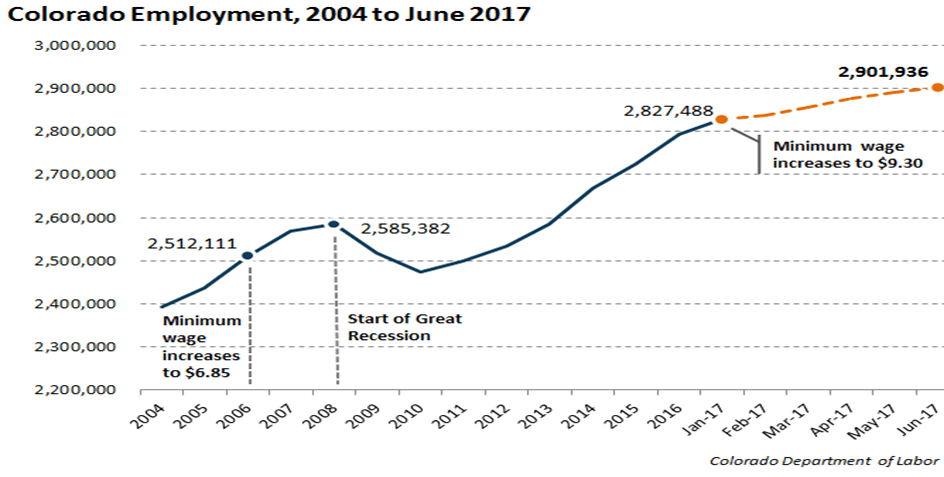
Last November, Colorado voters approved Amendment 70 raising the state’s minimum wage from $8.31 to $12 an hour by 2020. The first step increase occurred on Jan. 1, with an 11.9 percent increase in the minimum wage to $9.30 an hour.
According to data from the Colorado Department of Labor and Employment, job growth has been robust across the state in the first six months of 2017. In fact, Colorado has one of the strongest performing economies in the country with an unemployment rate of 2.3 percent.
The federal minimum wage was last raised from $6.55 to $7.25 in 2009. Currently 29 states have a minimum wage higher than the federal minimum. In 2017 alone, 19 states moved to raise their minimum wage reflecting growing concern about stagnant wages particularly for low wage workers.
In Colorado, while job growth has been strong in the state for the last six years, wages have not kept pace with the rising cost of living across the state. This is particularly true for low-wage workers. In 2015, workers at the 20th percentile of earners in the state were earning less than they did in 2000.
Despite dire predictions of job loss by the opponents of Amendment 70, job growth has been strong across the state following the first minimum wage increase. Statewide employment increased by 74,500. Rural counties experienced an increase of nearly 7,000 more people employed in the first six months of 2017.
Raising wages for the lowest paid Coloradans was the right thing to do. When hardworking Coloradans earn enough money to support their basic needs, they spend it in the local economy benefiting communities across the state.
– Michelle Webster
Recent articles
CCLP testifies in support of price transparency consumer protections
Charles Brennan provided testimony in support of HB26-1012, which would have required sellers to provide consumers with the prices of the delivered goods and the goods available at the store for price transparency and fairness. It also would have prohibited unfair or deceptive trade practices by charging unreasonably excessive prices for goods and services.
CCLP testifies in support of worker protections
Chris Nelson provided testimony in strong support of House Bill 26-1054, which would allow Colorado to step in to address declining workplace safety standards due to federal rollbacks and decline in enforcement, and allows for individual workers and labor unions to enforce their rights through private right of action.
CCLP testifies against HOAs requiring “proof of need” for language access
Morgan Turner provided testimony against HB26-1201 which would require owner's to provide "proof of need" prior to HOAs providing correspondence and notices in a language other than English.
CCLP testifies in support of ITINs for non-educational opportunities
Milena Tayah provided testimony in support of HB26-1143, which addresses the background check barrier for educational opportunities. It would require that an ITIN be allowed in lieu of a SSN when required for these background checks.